Tronxy Gemini S Reviews: See Why 0 Shoppers Rated It 0 Stars!
We gathered 0 reviews of the Tronxy Gemini S 3d printer to answer one thing: Does it live up to its 0/5 score?
 Supermod
 Moderator
 Recaptor
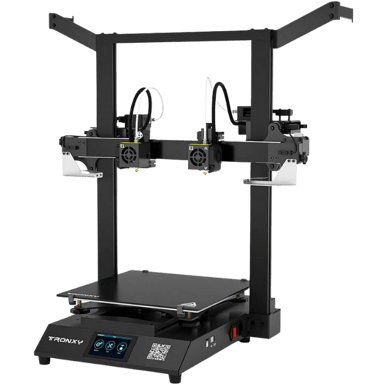
Tronxy Gemini S 3D Printer Review: A Robust Dual-Extruder Option for Advanced Users
In the fast-evolving landscape of consumer and professional 3D printing, the Tronxy Gemini S stands out as a noteworthy contender. Unveiled in 2021, this dual-extruder FDM printer is designed for intermediate to experienced users who seek quality, versatility, and sizable build capabilities without venturing into ultra-premium pricing. On paper, it boasts a solid combination of features, such as independent dual extrusion, a generous build volume, and compatibility with a variety of filaments, that speak to its ambition to support both prototyping and intricate multi-material printing. But does it truly meet the demands of advanced makers and educators? This review breaks down the Gemini S's specifications and evaluates what it offers to the 3D printing community with a scrutiny grounded in measurable data.
Detailed Specs & Features
Based on its engineering data, the Gemini S is categorized under FDM/FFF technology, which leverages fused filament fabrication to create objects layer by layer. It boasts a build volume of 11.81 by 11.81 by 15.35 inches (2142 cubic inches), affording users substantial room for medium to large projects. The printer features two independent extruders supporting multi-material printing with compatibility for PLA, ABS, TPU, PETG, and PVA filaments.
This flexibility is critical for professionals engaged in prototyping or creating complex miniatures that require different material properties in one print. The standard nozzle diameter is 0.4mm, with an option to swap to nozzles as fine as 0.2mm or as wide as 0.8mm, allowing for either high detail or faster extrusion rates. The printer's maximum extruder temperature peaks at 527°F, suitable for a broad range of filaments, while the heat bed reaches up to 212°F, essential for proper adhesion of ABS and similar materials.
The presence of a 4.3-inch touchscreen display offers user-friendly control, enhanced further by features like filament runout detection and power loss recovery, which help reduce print failures. Power-wise, the Gemini S operates on an internal supply compatible with 110-220 volts, consuming 360 watts during operation and just 15 watts while idle. Such specifications suggest a printer that is efficient but not optimized for energy saving; it lacks an energy-saving mode. Notably, it carries CE, FCC, and RoHS certifications, confirming compliance with safety and environmental standards.
User Experience & Performance (Based on Specs)
Design & Build
In daily use, the Cartesian frame with an open enclosure provides straightforward access to the build plate and extruders, which aids in setup and maintenance. However, it offers no protection from dust or external airflow, potentially impacting filament adhesion and print quality for temperature-sensitive filaments. The printer's size and weight (about 28.4 lbs) keep it relatively portable within professional or educational settings, but assembly is required as it ships in kit form; something intermediate to advanced users will find manageable.Performance
When evaluating print speeds, the Gemini S claims an official maximum of 120mm/s, yet its effective operational speed balances at about 60mm/s for reliable quality. This trade-off is typical for printers balancing speed and precision. The manual first-layer calibration and glass build plate ensure solid adhesion, although users hoping for fully automatic calibration might find this less convenient. Print accuracy is rated at 100 microns, promising detailed results suitable for professional prototyping. The machine supports print recovery, allowing long print jobs, up to 100 hours, to recover from interruptions, which is impressive for an FDM printer in this class.Connectivity & Software
Connectivity options are somewhat basic, limited to USB and TF card, with no remote monitoring or cloud functionalities; a factor that might deter users looking for advanced print farm integration. Fortunately, the Gemini S supports common slicers such as Cura and Simplify3D, allowing flexibility in workflow without mandatory proprietary software. Firmware updates are manual and must be done locally, in line with its no-cloud design.Extra Features
While it lacks some advanced sensors like filament jam detection or vibration compensation, it does incorporate two safety sensors plus critical safety provisions like overheat protection and a fireproof build plate, reinforcing a reliable and secure printing environment. The printer is designed for sustainability with replaceable nozzles and readily available spare parts, which extend its lifecycle and reduce downtime.Pros & Cons
Pros
- Dual independent extruders enable multi-material printing for versatile projects.
- Generous build volume supporting a wide range of prototyping needs.
- Solid safety certifications and built-in safeguards enhance user confidence.
- Features like filament runout sensor and power loss recovery minimize print failures.
- Broad compatibility with filament types, including third-party materials.
Cons
- Lacks an enclosed printing environment, limiting temperature-sensitive material use.
- No energy-saving mode, which may be a downside for power-conscious users.
- Relies on manual first-layer calibration, which could increase setup time.
- Absence of remote monitoring and cloud-based controls limits flexibility for print farm management.
Price & Value For Money
Priced at $511.99 at Tronxy, this printer presents a compelling value proposition. Given its 1-year warranty and robust feature set, especially dual independent extruders and solid build volume, the pricing feels justified in the mid-tier FDM market. It's particularly well-suited for users who want to explore dual-color or multi-material printing without upgrading to a pricier industrial model. However, those requiring advanced remote controls or enclosed printing might find better options at higher price points.Quick Take
In short, the Gemini S offers an impressive balance between advanced features and affordability. If we look at the numbers alone, its dual extrusion and user safety certifications make it a strong candidate for professionals and serious hobbyists aiming for multi-material prints. The trade-offs around enclosure and remote features are worth noting, but may not diminish its appeal for its intended user levels.Closing Recommendation
The Tronxy Gemini S may be ideal for intermediate to advanced users who value print versatility and build size but do not require extensive remote monitoring or energy-saving features. Its dual extruder system and broad filament compatibility help users achieve detailed, multi-material results with dependable safety standards. For workshop or classroom environments where assembly is not a hurdle, it offers measurable capabilities that align well with modern prototyping needs.Verdict
Rating: Based on the specifications and overall feature set, we believe Tronxy Gemini S deserves 4.2 out of 5.
- Winner Feature => Independent dual extruders unlock versatile multi-material printing capability.
- Needs Improvement => Absence of enclosure and energy-saving functions limits material range and efficiency.
Reviews 0
The good, the bad, and the brutally honest.Average Rating

More 3D Printers 453
Unlock more awesome finds.